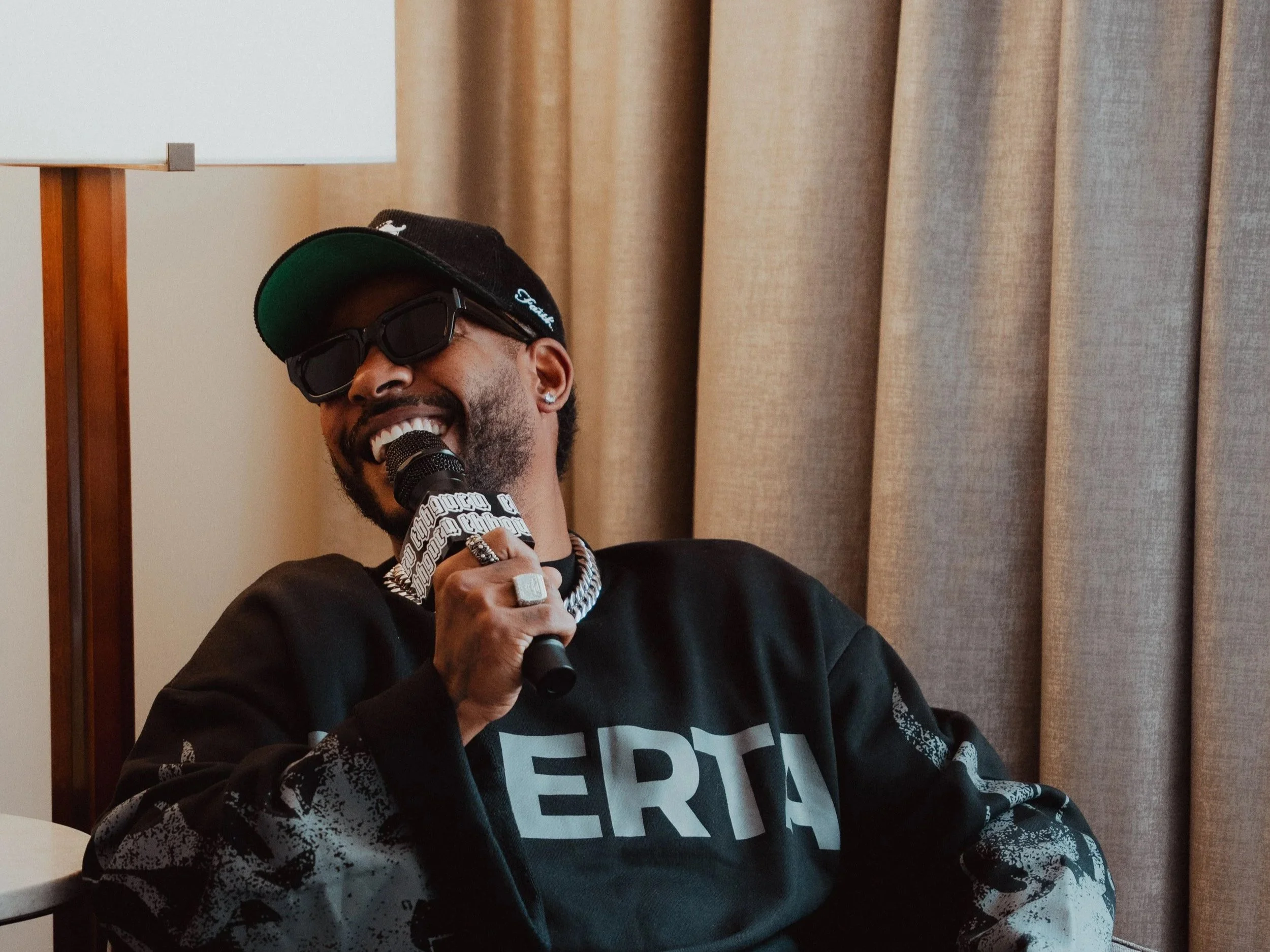

Beyond the Credits: DËRA Is Still Listening
Written and Interviewed by Ada Ley Diop, a conversation with TheHipHopGuru (instagram: @deratheboy)
When DËRATHEBOY was young, he watched the Grammys from the floor of his home in Ikeja. The people on the television seemed impossibly far away. He could see the stage and hear the music, but he could not imagine how someone from his part of Lagos was supposed to get there.
“It looked so far away,” he tells me.
Years later, a piece of music he made travelled onto an album that won one. Dëra produced Joeboy’s “Empty My Pocket,” which was used in Bad Bunny’s “Enséñame a Bailar.” The song appeared on Un Verano Sin Ti, winner of the 2023 Grammy for Best Música Urbana Album. Dëra is now listed as a songwriter on the track.
Recognition altered the way people received him. In some rooms, he no longer had to explain who he was; someone had already heard his work and was ready to trust his judgment. He travelled more. He could bring an idea to artists who might once have been out of reach. As we talk, though, he is most animated by the music he has yet to make.
Before we get far into his career, Dëra asks about my name. We discover our shared West African roots, talk about Senegal, and end up debating jollof rice. He has been to Dakar; he is also Nigerian. Somehow, he still gives Senegalese jollof its due, as he should!
His father, a physicist, loved music. A song might be playing while people went about the day, until Dëra noticed the room had changed. Someone was dancing. Someone else had gone quiet. Nobody had announced what they were feeling, but everyone had heard it.
Certain records still return him to those rooms. As he grew older, he began asking what inside the music had moved people. His attention slipped behind the singer: a drum pattern, the bass, a bit of harmony, a sound so small it might pass through the song only once. He imagined taking one of them away. He imagined bringing it back somewhere else.
“I wasn’t listening to music anymore,” he says. “I was interacting with it.”
For years, Dëra assumed everyone did this. Growing older taught him that hearing what a record might become was unusual, although he separates that instinct from the skill he has had to develop. The work has sharpened his ear. It has also given him more ways to question it.
Drake was one of the artists who made him want to produce. I asked for one song that stayed with him. Dëra names “Houstonatlantavegas,” and I know immediately that we are in trouble. Then Thank Me Later. Then “Fancy.” Then “Tuscan Leather.” I had asked for one song; apparently I am getting the syllabus. Five minutes later, I’m teaching half the class. As two devoted fans of the owl, we were one deep cut away from forgetting this was an interview.
We move through the producers who understood what to place around Drake’s voice, the songs everybody knows and the ones that tell you how closely somebody has listened. What Dëra keeps returning to is what a record does to the ear: a change in sound, the space left around a voice, the choices that make an artist’s world feel so complete you can still find your way into it years later. Eventually we pull ourselves back.
At university, Dëra thought for a while that he might sing. He made beats with his own voice in mind, spent time trying to become the artist who would use them, and learned from his friends’ reactions that they were more convinced by the music beneath his vocals. He laughs about it now. The experiment stayed with him, even after he gave production his full attention: he knows what it is to stand on the other side of one of his beats and look for somewhere to enter.
Drums he can play. He is learning guitar. Keyboard is the instrument people assume he plays when they hear how musically layered his records are; he tells me he does not. Much of his work happens on a laptop, following a sound he can hear before he knows exactly how to build it.

Some days the drums come first. Sometimes he starts with a sample. Often he makes everything from scratch. His answer changes as he talks because the process changes with the song, and especially with the artist.
A polished demo alone will not persuade him. A tone might. So might be a strange turn of phrase or an imperfection nobody else would think to keep.
“I’m not thinking, ‘What beat can I give?’” he says. “I’m thinking, ‘What can we discover together that maybe neither of us would arrive at separately?’”
He asks artists what frightens them, what they miss, what they have been listening to and who they hope to become. He notices the song they play him twice, the idea they reject too quickly, the thing they are trying to say but cannot quite get out. A studio, in his telling, has to make room for a bad first attempt. Otherwise, how would anyone get to the good one?
“Producing is partly listening to music,” he says, “but it’s also learning how to listen to the person.”
Before he had much evidence of where that work could take him, he had Sarz. Dëra watched a Nigerian producer make records that travelled beyond Nigeria and saw a future he could place himself inside. Years later, meeting Sarz still affected him more than meeting artists he had admired.
“Sarz made all of us believe that we could make it as producers outside Nigeria.”
Joeboy knew Dëra before either of them had the careers people now associate with their names. They lived together before Joeboy’s breakthrough, after Dëra left a strict home environment and stayed with his friend.
“We would struggle together when we didn’t have anything,” Dëra says.
These days they are rarely in the same city long enough to work. They still speak regularly. Dëra has new ideas he wants Joeboy to hear, and he sounds impatient for the day their schedules finally make space for them. Listening to him, I realise how often I have been asking about records when he has been answering with relationships.
Success brought him into more rooms. It also introduced a problem he had not expected to have: once people loved something he made, he could feel the pull to make it again. Dëra listens beyond his habits to resist it. Different countries, different generations, genres he knows little about. If something irritates his ear, he sometimes stays with it to find out why.
He hears that willingness to ignore familiar boundaries in younger Nigerian artists and producers. When Dëra was starting out, he slept on studio floors and figured things out himself, unless he was lucky enough to meet someone willing to teach him. Now a producer can watch someone explain a technique from another country and send that person an idea before the day is over. Some of the music that follows sounds strange to Dëra at first. Then he listens again.
“I wouldn’t necessarily trade my journey for theirs,” he says, “but I definitely try to borrow some of their fearlessness.”
I have a soft spot for the people who help build an artist’s world from the side of the frame. They know which “final” song had several previous lives, whose doubtful idea became the best one, and what happened when the room went quiet. Their version still has fingerprints on it.
He brought that curiosity into his work with Victony. They had known each other for years. Dëra had been around during Victony’s shift from rap towards singing, and they had collaborated on “CHOP & SLIDE.” Somehow, they had still never built a regular practice of making music together. They would run into each other, joke around and go their separate ways.
In December 2025, Dëra asked why they kept doing that. They booked a session.
They made “TYPO” in Victony’s bedroom, with speakers resting on the bed. Other songs followed in Nigeria and Los Angeles. When they could not meet, they sent files and finished ideas over FaceTime.
While Dëra and I are talking through the album, Victony enters the room. They are together in Texas, still working after STARLIFE has come out. Dëra tells him we are speaking about his album and asks if he wants to say hello. Victony can see me, but the blurred background on Dëra’s screen keeps him out of my view. For a moment, I hear the person we have been discussing without seeing him. Then Dëra and I return to the interview.
Dëra knew listeners were attached to Victony’s earlier, more introspective music. He understood why some would hear STARLIFE and miss the version of the artist they first loved. But the Victony he worked with was having fun. Victony wanted to make music from where he stood now, without having to remain in an older chapter of his life.
“With this project, I never wanted the question to be, ‘How do we recreate the Victony people already know?’ Dëra says. “It was more about, ‘Who is Vic right now?’
In the studio, that question reached all the way down to a vocal take. Someone could sing every note correctly and leave Dëra unconvinced. A voice might crack on another take, or arrive a little late, and suddenly he believed the person singing.
“Being able to sing something and being able to convince me of it are two completely different things.”
Victony and Ozedikus had begun “SLICK” in Nigeria before Victony sent Dëra an early version. Dëra liked it, heard another direction and reworked the song within hours. Days later, he opened Instagram to find Victony already teasing it.
When I ask which track most clearly carries his touch, he chooses “SLICK.” Both he and Victony are Igbo. Dëra hears Igbo highlife in its guitar, particularly where the instrument answers the voice between lines. It is a sound he knows from the east of Nigeria, carried into the song they were making together.
On “AMAZON,” they began with a sample by a young producer named Ay0ley. Dëra spent hours looking for him when they needed to clear the record. The person behind the sound had to be found.
“Even if you put a dot on the production, you must get credited,” he says.
I tell Dëra that I played “MISSIN PIECE” four times during a walk. He calls it a Victony kind of song. I know what he means. I have spent the whole conversation trying to understand how many people it takes to make a song feel that much like one person.
Then there is “TOO LIT.” Dëra and Victony made it during their last session for STARLIFE in Los Angeles. Dëra thought they were playing around. Victony wanted it on the album, and they went back and forth until Dëra let the choice stand.
It became the opening track. “TYPO,” the first song they had made, landed near the album’s end. When I point out the order, Dëra pauses, then laughs.
“I never thought about that.”
Now he is working towards a producer-led project of his own. He has songs he believes in that did not find a home elsewhere, and he wants to bring artists together around sounds drawn from different parts of his life in music. He will choose the collaborators, the songs and their order. After years of entering another artist’s world, he is preparing to ask people into his.
That means press, photographs and a greater public presence, subjects he approaches with considerably less certainty than the music. But he knows what he wants the record to sound like.
“It’s going to sound like me,” he says. “It’s going to sound like what I personally consider music.”
Near the end of our conversation, I ask what makes a great producer. When he was younger, Dëra says, he thought greatness meant arriving with the best drums, the best melodies and the answer whenever a record stalled. He has become more interested in knowing when to leave a sound alone.
“Sometimes the greatest contribution you can make is creating the environment for somebody else to have the idea.”
He is still learning how to make that room.